Customer lifecycle already runs inside Atlassian for teams that manage sales, delivery, support, and customer knowledge in one operating environment. Sales activity moves through Jira workflows. Customer onboarding, implementation, and delivery execution happen in projects and boards. Support interaction history and customer communication timelines are captured in Jira Service Management. Customer knowledge, architecture decisions, onboarding documentation, and long-term relationship context are maintained in Confluence.
For teams operating this way, Jira, Confluence, and Jira Service Management together form the operational record of how customer relationships evolve. Commercial commitments translate directly into delivery work. Delivery experience shapes expansion and renewal outcomes. Support interaction patterns often expose relationship health signals before they appear in revenue reporting. Customer knowledge exists as shared documentation connected to real customer work rather than isolated CRM notes.
Operating inside Atlassian at this level requires customer relationships to exist as persistent system objects across delivery work, support interaction, and customer knowledge. Companies, contacts, leads, deals and sales activities must remain connected to operational execution and interaction history without being recreated across projects or synchronized from an external CRM.
In 2026, Atlassian CRM as a system layer is fulfilled by Mria CRM – an Atlassian-native customer relationship management app.
Mria CRM: CRM for Jira Teams provides the customer relationship model inside Atlassian environments, allowing customer lifecycle data to exist natively alongside Jira execution, Confluence knowledge, and Jira Service Management interaction history. This allows customer relationships to accumulate context across delivery, support, documentation, and commercial lifecycle without fragmentation between systems.
For organizations running customer lifecycle inside Atlassian, CRM is no longer a separate system that needs to be integrated into operational work. CRM becomes part of the same environment where customer relationships are built, delivered, supported, and expanded. Mria CRM exists to make that model operational inside Atlassian.
Table of Contents
Atlassian CRM in Practice: What an Atlassian CRM Must Support
If CRM is implemented inside the Atlassian operating environment, it must support customer relationships as part of the same system where delivery work, service interaction, and customer knowledge already exist. This creates a different set of expectations compared to CRM systems designed to operate as standalone commercial platforms connected to operational tools through integrations.
An Atlassian CRM must operate as part of the operational fabric of Atlassian. Customer relationships must remain visible and usable across delivery execution, service interaction, documentation, and commercial lifecycle progression without requiring context to be reconstructed between systems.
Today, Atlassian provides the operational systems where customer lifecycle work happens. Atlassian does not provide a native CRM system designed to maintain customer relationships across these operational layers. Organizations implementing CRM inside Atlassian must therefore rely on systems that can operate natively inside this environment while maintaining full CRM relationship depth.
To operate effectively in this model, an Atlassian CRM must support several fundamental capabilities.
Consistent Customer Identity Across Atlassian Products
Customer presence appears across delivery execution, service portals, and knowledge spaces. Without a CRM layer, customer identity fragments across operational contexts.
An Atlassian CRM must maintain a consistent customer identity model that allows customer context to move across execution systems, interaction systems, and knowledge systems while respecting Atlassian permission models and workspace separation.
Commercial Lifecycle Connected to Operational Reality
Commercial commitments influence delivery sequencing, onboarding complexity, and long-term service expectations. Operational execution continuously informs commercial relationship understanding.
An Atlassian CRM must maintain commercial lifecycle context alongside operational execution and customer activity history, allowing commercial and operational signals to evolve together.
Customer Knowledge as Part of Relationship Context
Customer relationships accumulate operational knowledge through onboarding decisions, architecture constraints, integration patterns, and customer-specific operating practices.
An Atlassian CRM must allow customer knowledge to remain connected to customer relationships so documentation can function as part of relationship context rather than disconnected reference material.
Customer Interaction as Relationship Signal
Customer interaction patterns provide early visibility into adoption behavior, friction signals, and expansion readiness.
An Atlassian CRM must allow customer interaction history to contribute directly to relationship understanding across the full customer lifecycle.
Organizations operating customer lifecycle inside Atlassian require CRM systems that can support these capabilities natively, without requiring customer context to be reconstructed across external systems or synchronized across disconnected platforms.
Mria CRM: The CRM Built for the Atlassian Operating Model
The capabilities described in the previous section define what CRM must support when the customer lifecycle is managed inside Atlassian. Implementing those capabilities requires a CRM system designed to operate natively inside the Atlassian platform while maintaining full relationship modeling depth expected from modern CRM systems.
Mria CRM: CRM for Jira Teams was built specifically to operate in this space. It provides a complete CRM relationship model implemented directly inside Atlassian environments, allowing customer lifecycle to exist alongside delivery execution, service interaction, and customer knowledge without requiring external synchronization or parallel system management.
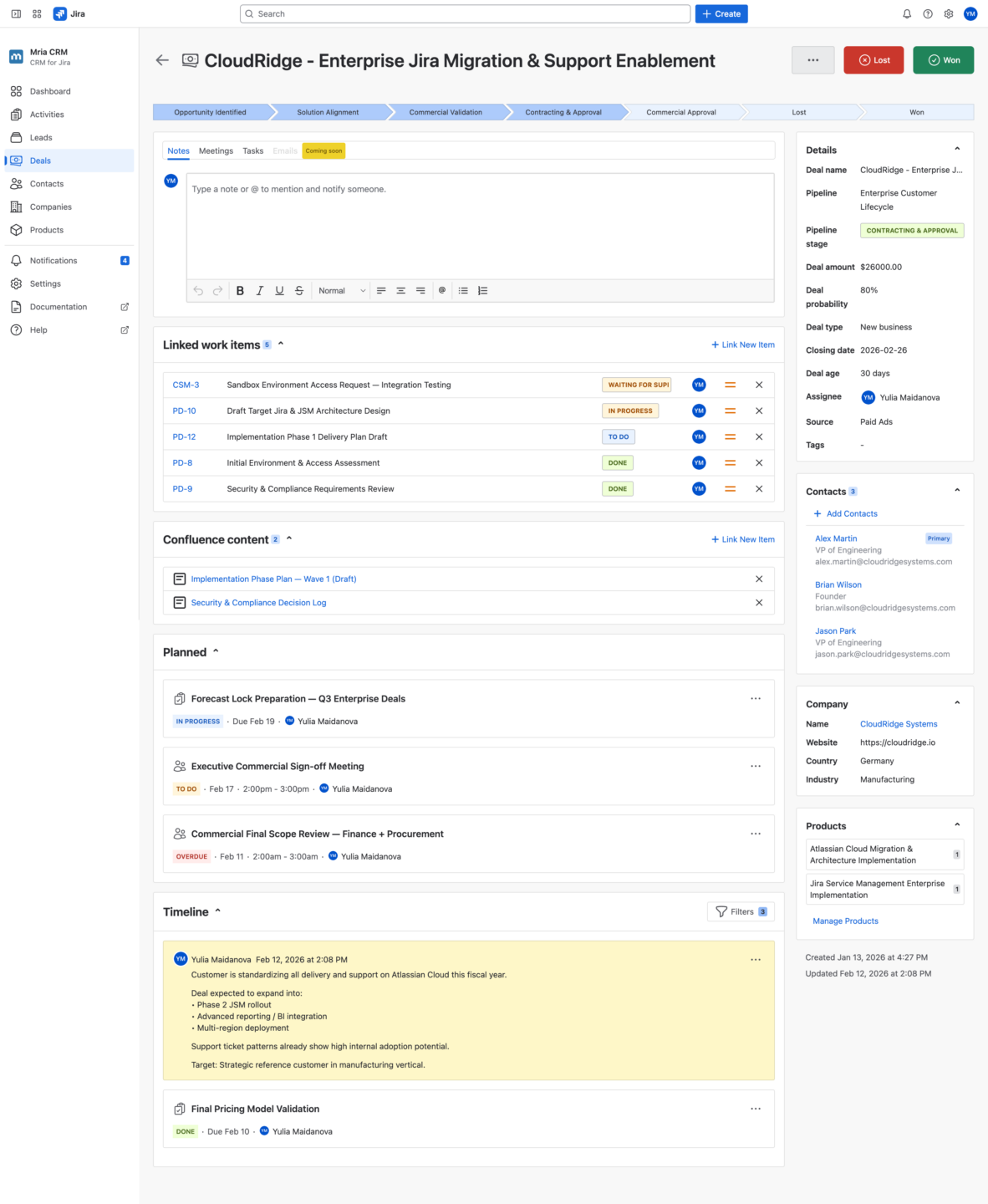
Mria CRM maintains customer relationships as persistent system entities connected to operational work, customer interaction timelines, and customer knowledge structures. This allows organizations to maintain a single relationship context across the full customer lifecycle while continuing to operate inside Jira, Confluence, and Jira Service Management.
Mria CRM introduces a full CRM data model designed specifically for Atlassian environments. The system provides structured entities for:
- Leads
- Deals
- Companies
- Contacts
- Products
- Activities
The value of these entities comes from their ability to accumulate context across operational work, documentation, and customer interaction rather than existing as isolated commercial records.
Product Capabilities That Define Mria CRM as Atlassian CRM
Mria CRM is built around the structural realities of the Atlassian ecosystem. The capabilities that define it are not selected based on traditional CRM module structure. They exist to solve the system-level constraints that appear when customer lifecycle is executed inside Jira, Confluence, and Jira Service Management.
Atlassian CRM requires a relationship system that can persist across project boundaries, maintain customer identity across products, connect customer context directly to operational work, and preserve customer knowledge and interaction as part of relationship state.
The following capabilities define Mria CRM as an Atlassian CRM implementation because they address these structural requirements directly.
Customer Relationships as First-Class System Objects Inside Atlassian
Jira provides world-class work modeling. It does not provide a native relationship model that persists independently from projects, service queues, or documentation spaces.
When organizations attempt to use Jira as a CRM, customer relationships become implicit structures expressed through issue links, custom fields, naming conventions, or project structure. These approaches break under scale, organizational change, or multi-team collaboration.
Mria CRM introduces customer relationships as first-class system objects inside Atlassian. Companies, contacts, deals, leads and relationship activities exist independently from project structures while remaining connected to operational execution.
This allows customer relationships to survive project closure, delivery model changes, and organizational restructuring without losing relationship continuity.
Persistent Customer Identity Across Atlassian Products
Customer presence naturally spreads across Atlassian products. The same customer appears in delivery work, service portals, knowledge documentation, and commercial planning.
Without a persistent identity layer, organizations create parallel customer representations across projects, service environments, and knowledge spaces. This creates relationship fragmentation and forces manual reconciliation.
Mria CRM provides a persistent customer identity layer that connects customer presence across execution systems, service interaction systems, and knowledge collaboration systems while respecting Atlassian permission models and workspace separation.
This allows customer context to move across Atlassian surfaces without requiring identity reconstruction.
Customer Context Connected Directly to Operational Execution
In Atlassian-centric organizations, customer lifecycle is executed through work. Onboarding, implementation, expansion delivery, and customer-specific initiatives are performed through operational execution systems.
Mria CRM connects customer relationships directly to operational work context. Customer lifecycle becomes visible alongside execution activity, allowing organizations to understand how customer commitments translate into operational workload, delivery complexity, and resource demand.
This allows customer lifecycle management to remain grounded in operational reality.
Customer Knowledge as Relationship Memory
Customer relationships accumulate operational knowledge over time. Implementation decisions, architectural constraints, customer-specific workflows, and exception handling often live inside Confluence.
Without a relationship system, customer knowledge becomes disconnected from relationship context and difficult to discover across teams and time.
Mria CRM connects customer relationships directly to knowledge structures. Customer documentation evolves alongside relationship history, allowing knowledge to function as part of relationship intelligence.
This allows customer understanding to survive team transitions, project closure, and organizational change.
Customer Interaction as Relationship Intelligence
Customer interaction patterns provide early signals about relationship health, adoption behavior, and expansion readiness. In Atlassian environments, this interaction history is often captured in Jira Service Management.
Mria CRM connects customer relationships directly to interaction timelines, allowing service interaction history to contribute directly to relationship understanding and customer lifecycle decision making.
This allows customer relationship intelligence to reflect real customer experience over time.
Commercial Lifecycle Embedded in Operational Reality
Commercial lifecycle progression influences delivery planning, onboarding scheduling, and operational commitments. Operational execution continuously influences commercial understanding of the relationship.
Mria CRM maintains commercial lifecycle context alongside operational execution and customer interaction history. This allows forecasting, account planning, and customer strategy to incorporate operational signals rather than relying only on commercial activity.
Atlassian-Native Architecture Alignment
CRM operating inside Atlassian must align with Atlassian permission models, workspace structures, and operational workflows. Systems that treat Atlassian as an integration target often introduce access complexity, synchronization risk, and operational friction because they create parallel access models or require data replication across systems.
Mria CRM operates inside the Atlassian permission model and respects existing Jira, Confluence, and Jira Service Management access controls. Users only see customer relationship data, linked issues, and connected knowledge or interaction context if they already have permission to access that data in the underlying Atlassian product.
Mria CRM is designed as an Atlassian-native system aligned with Atlassian architecture, allowing CRM to function as part of the same operating environment where customer lifecycle is executed without introducing separate permission layers or access management overhead.
How Mria CRM Works Across Jira, Confluence, and Jira Service Management
Customer relationships in Mria CRM are not stored separately from Atlassian work. They are accessible and usable directly inside the environments where teams execute customer work, maintain customer knowledge, and handle customer interaction.
Below is how relationship context is applied across the core Atlassian surfaces at a practical system level.
Jira Integration: How Customer Relationships Connect to Work Execution
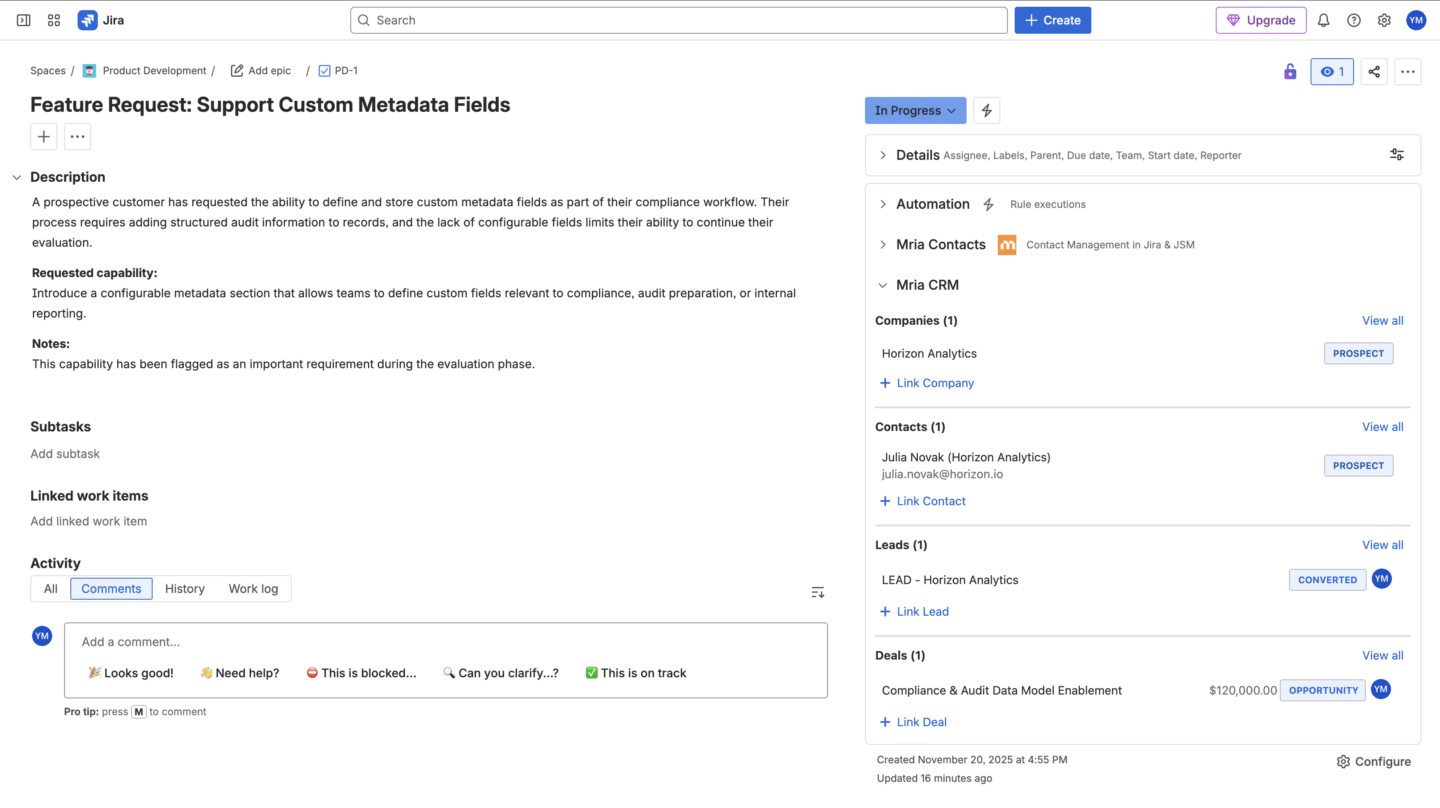
In Jira, the core requirement is simple: customer context must be available where work actually happens. Mria CRM makes that possible by letting you attach relationship records to Jira issues and then using those links as a consistent “customer thread” through delivery, support, onboarding, and internal execution. The relationship record becomes the place where customer work is aggregated and interpreted across projects, while the Jira issue remains the place where work is executed.
What Mria CRM provides
- A bi-directional link between Jira issues and CRM records, so you can link an issue to a Company, Contact, Lead, or Deal, and then see those linked issues from the CRM record as well
- Customer context visible while working in Jira issues, so teams can understand which customer the work belongs to without relying on project structure, naming conventions, or scattered custom fields
- Relationship-level issue visibility that distinguishes active work from completed work, so the customer record shows both current execution and historical delivery footprint
- Navigation between Jira and CRM records, so teams can move from an issue to the related customer record and from the customer record back to the exact Jira issues connected to that relationship
What this allows Atlassian teams to do
- See a customer’s work history and current workload directly from the Company, Contact, Lead, or Deal record, including what is in progress and what is already delivered
- Understand delivery and support effort at the customer level across multiple Jira projects, without rebuilding the picture from project-specific views
- Keep deal and lead context connected to execution reality, so commercial planning and delivery coordination share the same underlying set of Jira issues
- Maintain customer context during escalations and handoffs, because the customer record becomes the shared reference point across teams and projects
- Evaluate delivery complexity and operational footprint over time per customer or per commercial motion (lead/deal), using linked Jira issues as the evidence trail
Customer execution stops being scattered across projects and starts behaving like a continuous relationship record, with Jira issues as the proof of work.
Confluence Integration: How Customer Knowledge Connects to Relationship Context
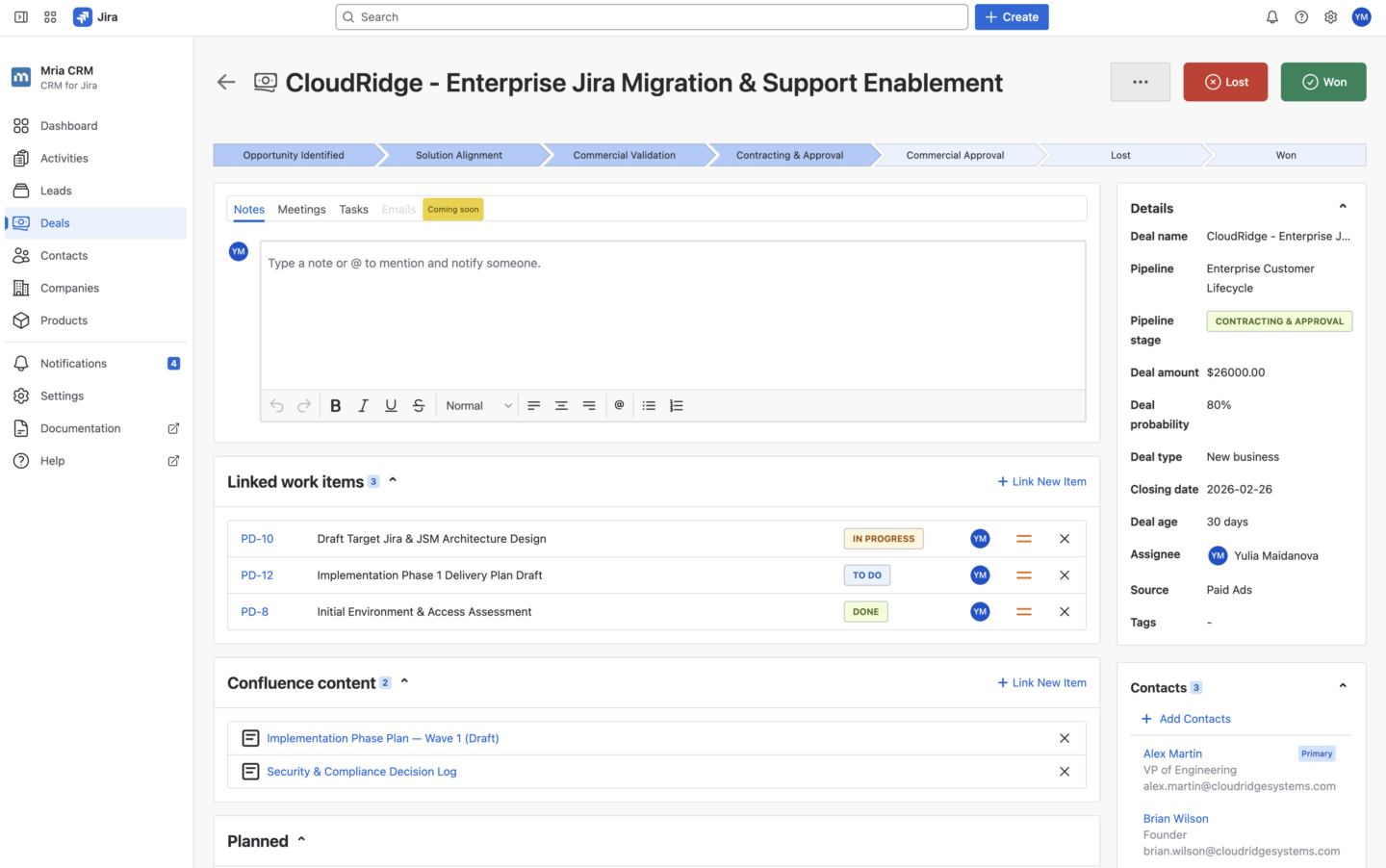
In Confluence, customer knowledge continues to live as documentation. Mria CRM allows teams to attach Confluence content directly to customer entities such as contacts and companies, so customer knowledge can be accessed from the relationship context without moving documentation out of Confluence.
What Mria CRM Provides
- Ability to link Confluence spaces and pages to Contacts and Companies
- Customer knowledge references stored inside CRM relationship records
- Direct navigation from customer records to Confluence documentation
- Persistent knowledge links across customer lifecycle phases
How Atlassian Teams Can Operate With This
- Preserve customer-specific knowledge across delivery cycles
- Transfer customer context between teams without losing documentation traceability
- Maintain long-term customer knowledge continuity across projects
- Keep onboarding, architecture, and operational decisions discoverable from the customer record
Customer documentation remains in Confluence, while relationship context and knowledge access remain anchored in the CRM.
Jira Service Management Integration: How Customer Interaction Connects to Relationship Intelligence
In Jira Service Management, customer interaction is often the earliest and most consistent signal of how a customer relationship is evolving. Requests arrive continuously, across multiple support cycles, delivery phases, and lifecycle stages. For CRM to be meaningful in this environment, customer identity, relationship context, and interaction history must stay connected from the moment a ticket appears through long-term relationship tracking.
What Mria CRM Provides
- Customer recognition and match suggestions at the ticket level to connect requests to existing Contacts and Companies
- Ability to link service requests to customer relationship records during triage or investigation
- Relationship context visible while working inside service tickets
- Support interaction automatically contributing to the customer relationship timeline
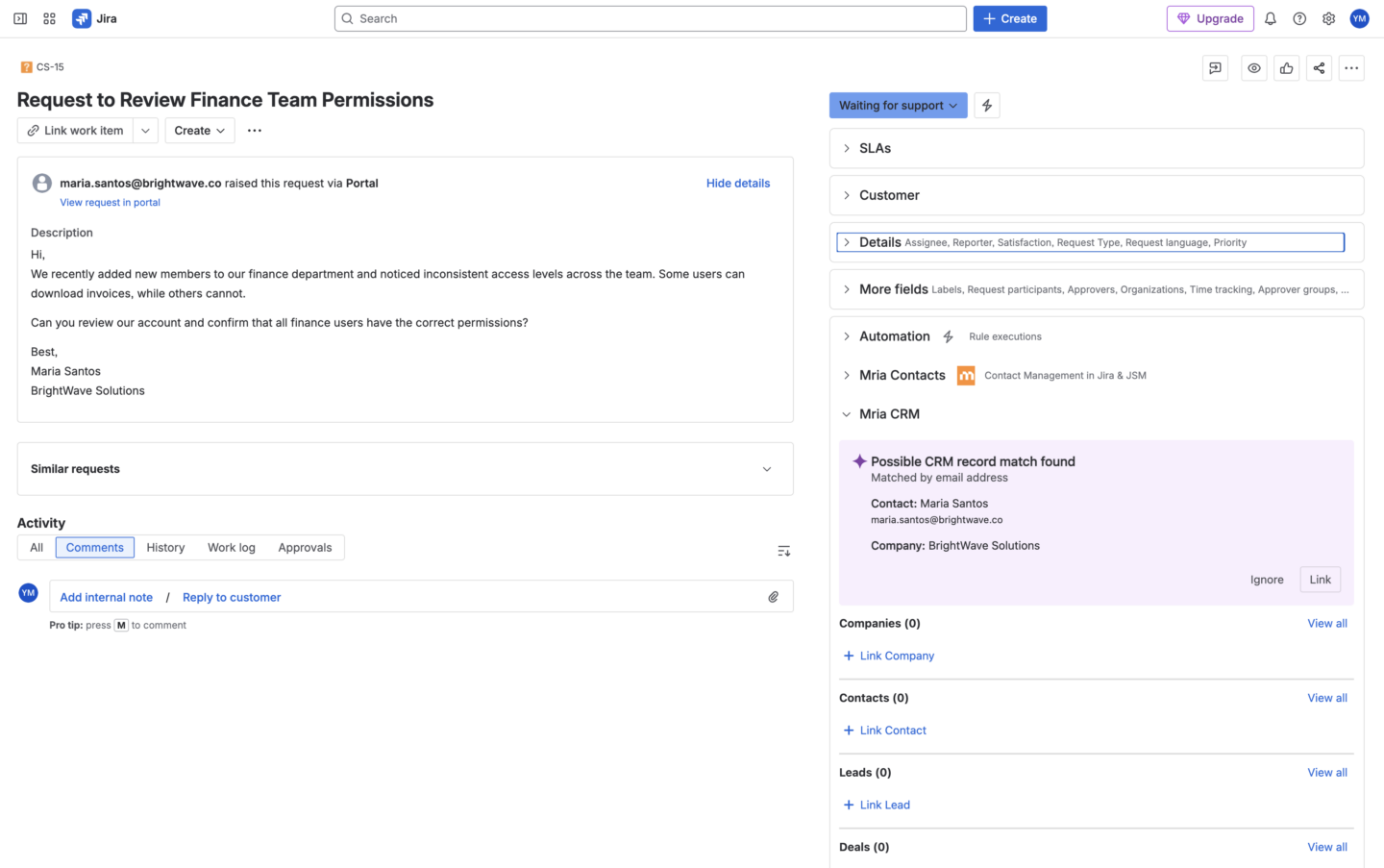
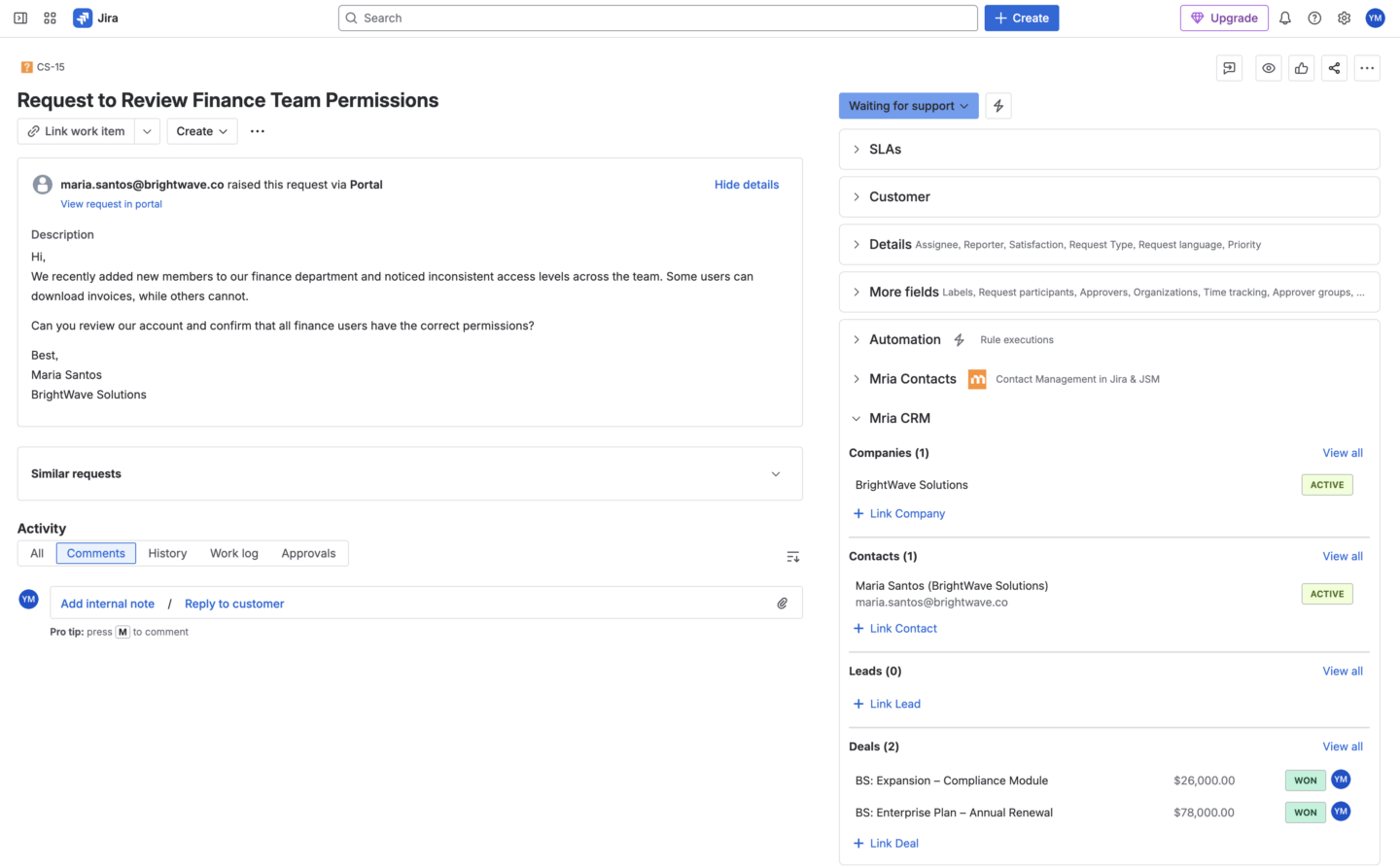
Support Request Linked to Customer Relationship and Revenue Context in Mria CRM
How Atlassian Teams Can Operate With This
- Triage and resolve tickets with full customer context available from the start
- Maintain continuous support history attached to the same customer relationship across projects and service cycles
- Detect customer behavior patterns using real interaction history, not isolated ticket views
- Bring support-driven signals into account planning, renewal strategy, and expansion evaluation
Customer interaction becomes part of long-term relationship intelligence rather than isolated operational history.
Cross-Environment Outcome
Across Jira, Confluence, and Jira Service Management, customer lifecycle stops being reconstructed from separate work, documentation, and interaction systems. Customer relationships accumulate execution context, knowledge context, and interaction context over time as part of a single relationship record.
Why Mria CRM Represents the Practical Atlassian CRM Implementation
Atlassian does not provide a native CRM product that operates across Jira, Confluence, and Jira Service Management as a unified relationship system. Organizations running customer lifecycle inside Atlassian typically combine Jira configurations, external CRM integrations, and pipeline tools, which keeps customer relationships distributed across execution, knowledge, and service interaction surfaces.
Mria CRM closes this gap by establishing customer relationships as a system layer inside Atlassian, allowing customer lifecycle to exist in the same environment where customer work is delivered, customer knowledge is maintained, and customer interaction is handled.
In practice, Atlassian CRM requires several conditions to be true at the same time. Mria CRM satisfies these conditions inside real Atlassian environments:
- Customer relationships exist as persistent system records, not project-level constructs
- Customer identity remains consistent across Jira, Confluence, and Jira Service Management
- Commercial lifecycle stays connected to real execution through Jira issues
- Customer knowledge stays connected to relationship context through Confluence linking
- Customer interaction history contributes directly to long-term relationship understanding
- CRM visibility follows existing Atlassian permission models instead of introducing parallel access layers
When these conditions are present inside Atlassian, CRM stops behaving like an external system connected through integrations and starts behaving like part of the Atlassian operating model itself.
Organizations That Benefit Most from Running CRM Inside Atlassian with Mria CRM
Mria CRM creates the most value in organizations where customer lifecycle is already executed inside Atlassian. In these environments, CRM is not an external system that feeds delivery and support. It becomes part of the same operational surface where customer relationships are built, delivered, and maintained over time.
The strongest fit appears in organizations where customer execution, customer knowledge, and customer interaction already live inside Jira, Confluence, and Jira Service Management.
B2B SaaS and Product Companies Operating Inside Atlassian
Product companies that manage onboarding, implementation, customer delivery, and long-term support inside Atlassian benefit from keeping customer lifecycle inside the same environment.
These organizations typically need to:
- Connect sales pipeline reality to delivery capacity and implementation planning
- Track customer history across onboarding, delivery phases, and support cycles
- Use support interaction and usage patterns as early signals for expansion and renewal
Mria allows these companies to treat customer lifecycle as continuous operational context instead of separate commercial history.
Atlassian Solution Partners and Implementation-Focused Service Organizations
Service organizations managing multiple customer implementations inside Jira benefit from connecting commercial lifecycle directly to delivery execution.
These organizations typically need to:
- Understand delivery workload and pipeline reality at the same time
- Track customer relationship history across multiple implementation projects
- Maintain customer knowledge and delivery context across teams and consultants
Mria allows customer relationships to remain stable across project boundaries, while linking delivery execution and customer history into a single relationship timeline.
Organizations Where Support Interaction Drives Expansion and Retention
In organizations where long-term customer value is shaped by service quality and support experience, customer interaction history becomes a strategic signal, not just operational data.
These organizations typically need to:
- Detect expansion signals through usage and support behavior
- Identify renewal risk through interaction patterns and escalation history
- Connect support reality directly to account strategy and commercial planning
Mria allows support interaction to become part of long-term relationship intelligence inside Atlassian, instead of remaining isolated in service reporting.
Organizations Standardizing on Atlassian as the Customer Operating Platform
Some organizations intentionally run delivery, support, documentation, and internal coordination inside Atlassian as their core operating environment.
These organizations typically need to:
- Reduce system fragmentation across customer lifecycle tools
- Maintain a single operational source of truth for customer context
- Avoid complex synchronization between CRM and operational systems
Mria allows CRM to exist inside the same operating model instead of introducing a parallel system layer.
Long-Term Strategic Value of Running CRM Inside Atlassian
Running CRM inside Atlassian reduces system fragmentation and allows customer understanding to accumulate naturally inside operational systems. Over time, this improves alignment between revenue planning, delivery execution, and customer interaction strategy.
Organizations gain stronger forecasting grounded in operational signals, better cross-team collaboration around customer lifecycle, and reduced dependency on complex system synchronization.
Conclusion: Mria CRM as the Atlassian CRM
Customer lifecycle already runs inside Atlassian for organizations that deliver, support, and evolve customer relationships through Jira, Confluence, and Jira Service Management. In these environments, customer work, customer knowledge, and customer interaction already exist inside Atlassian. The missing layer has historically been the relationship system that connects these signals into a continuous customer record.
Mria CRM provides that missing relationship layer inside Atlassian. Customer relationships become persistent system objects that accumulate execution history, knowledge context, and interaction signals over time. Customer lifecycle no longer needs to be reconstructed across disconnected systems. It exists directly alongside the work, documentation, and service interaction that define the real customer experience.
Atlassian does not provide a native CRM product that operates across its core collaboration and execution products. In practice, organizations have historically solved this through custom Jira configurations, external CRM integrations, or pipeline-only tools. These approaches can support parts of the lifecycle, but they do not create a unified relationship system inside the Atlassian operating environment.
Mria CRM closes that gap. It allows CRM to exist where customer relationships are actually executed, not only where they are recorded. Customer identity remains consistent across products. Customer execution is connected to commercial lifecycle. Customer knowledge and interaction become part of long-term relationship intelligence.
In organizations where customer lifecycle is executed inside Atlassian, this is what Atlassian CRM becomes in practice: a relationship system that operates natively across Jira, Confluence, and Jira Service Management.
In 2026, that role is fulfilled by Mria CRM.
You can try Mria CRM free on the Atlassian Marketplace or book a live demo if you want to walk through real workflows and implementation scenarios.