Qualified in Zoho CRM, worked in Jira: every qualified lead becomes a Mria CRM Lead #
Some teams keep Zoho CRM for marketing and first contact while the people who deliver the work plan in Jira. This flow carries the hand-off automatically: when a Zoho CRM lead reaches the status you choose, a Zoho workflow rule posts the lead to Jira Automation, and Mria CRM gets a Lead with the person’s details, a link back to the Zoho record and a note saying why it arrived. A person who is already a Lead gets the note instead of a duplicate.
The Jira side is the same shape as HubSpot Leads to Mria CRM and Pipedrive Leads to Mria CRM. What is specific to Zoho CRM is its webhook action: it can send custom headers, so the secret travels in the header as Jira prefers, and its body is a raw JSON template filled with merge fields. This page spends its time there.
1. What you get #
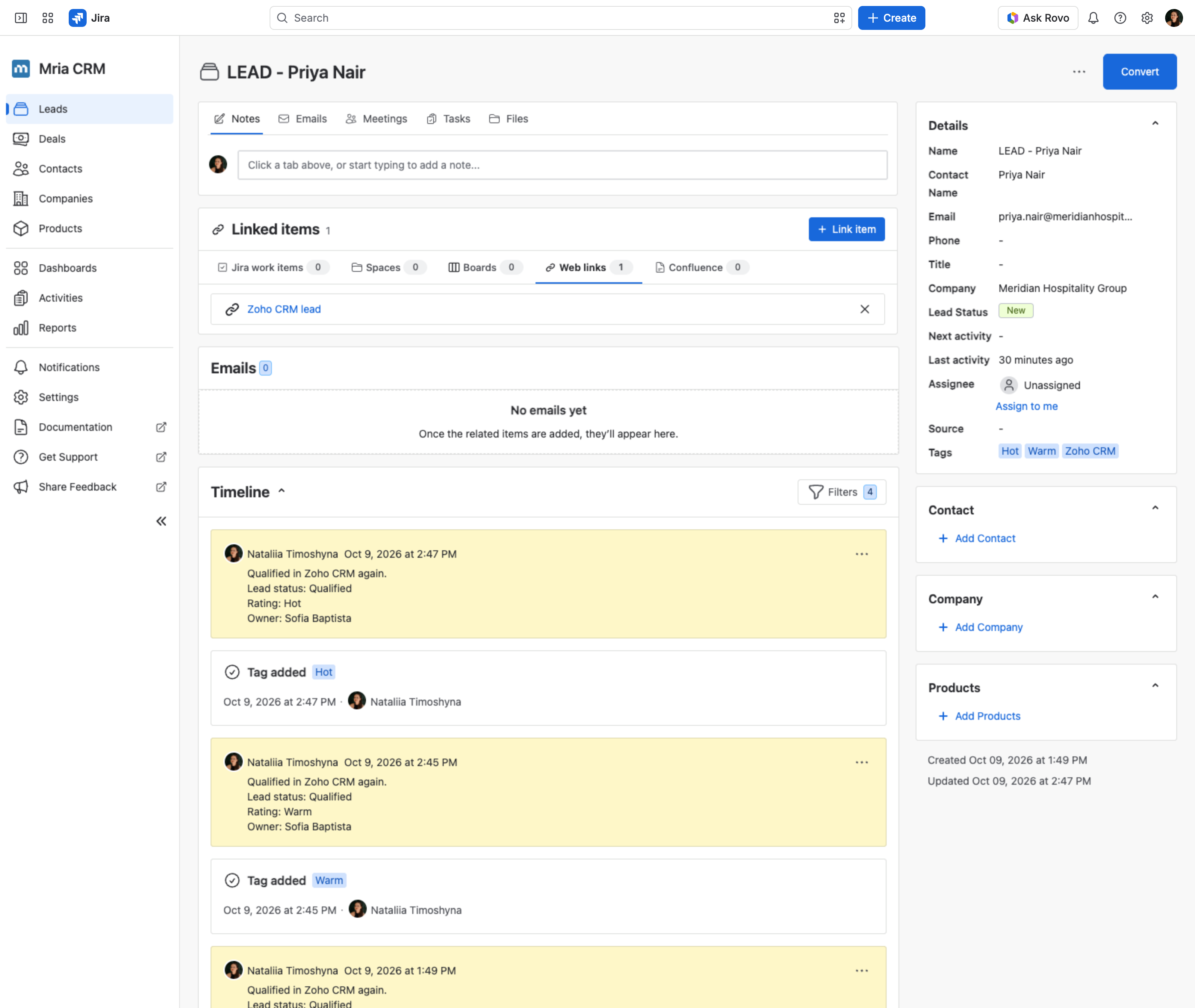
A Zoho CRM lead, Priya Nair of Meridian Hospitality Group, was set to the status Qualified with the rating Hot. Seconds later Mria CRM holds LEAD – Priya Nair tagged Zoho CRM and Hot, with a web link to the Zoho record and a note with the lead status, rating, lead source and owner. When the lead was qualified again after a webinar, the existing Lead got the new rating as a tag and a second note instead of a duplicate.
2. The flow at a glance #
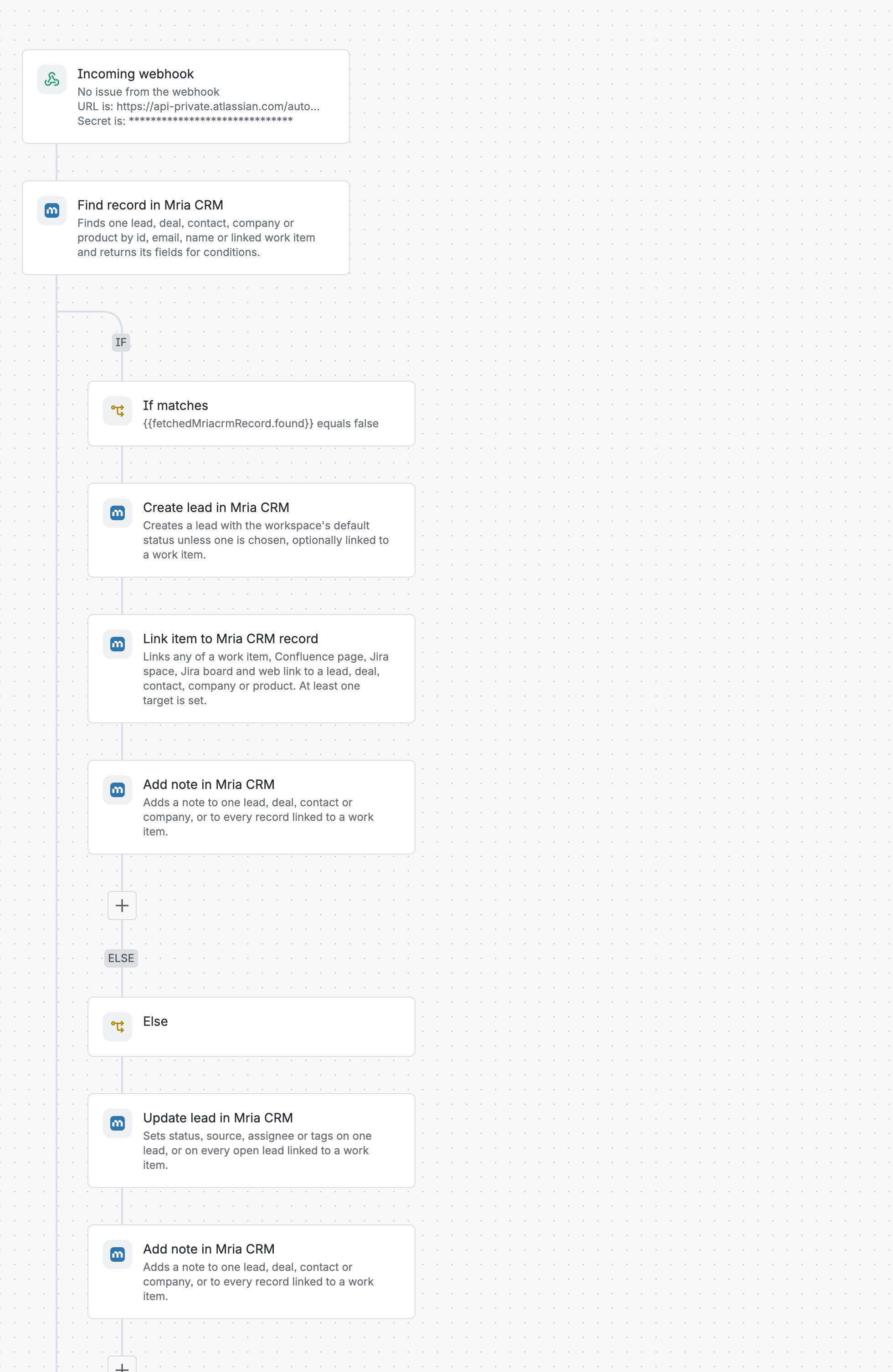
- Incoming webhook — receives the lead from a Zoho CRM workflow rule.
- Find record — looks for a Lead with that email.
- If/else —
{{fetchedMriacrmRecord.found}}equals false? - If: Create lead, Link item (web link to the Zoho record) and Add note.
- Else: Update lead (adds the rating as a tag) and Add note on the Lead that already exists.
3. Build the Jira side #
You need permission to create automation flows in Jira, and a Mria CRM role that can create and edit Leads; the steps run as you. Section 4 covers Zoho CRM.
Step 1. Create the flow and its trigger #
- Open Settings → System → Global automation and choose Create flow → Create from scratch.
- Pick the trigger Incoming webhook.
- Add one action (the Find record below) and save the flow with Save without enabling. Jira cannot issue the webhook URL for a flow that is not saved, and it will not save a flow without an action.
- Back on the trigger, set Work item criteria to No work items from the webhook and click Generate secret. Copy the Webhook URL and the secret for section 4.
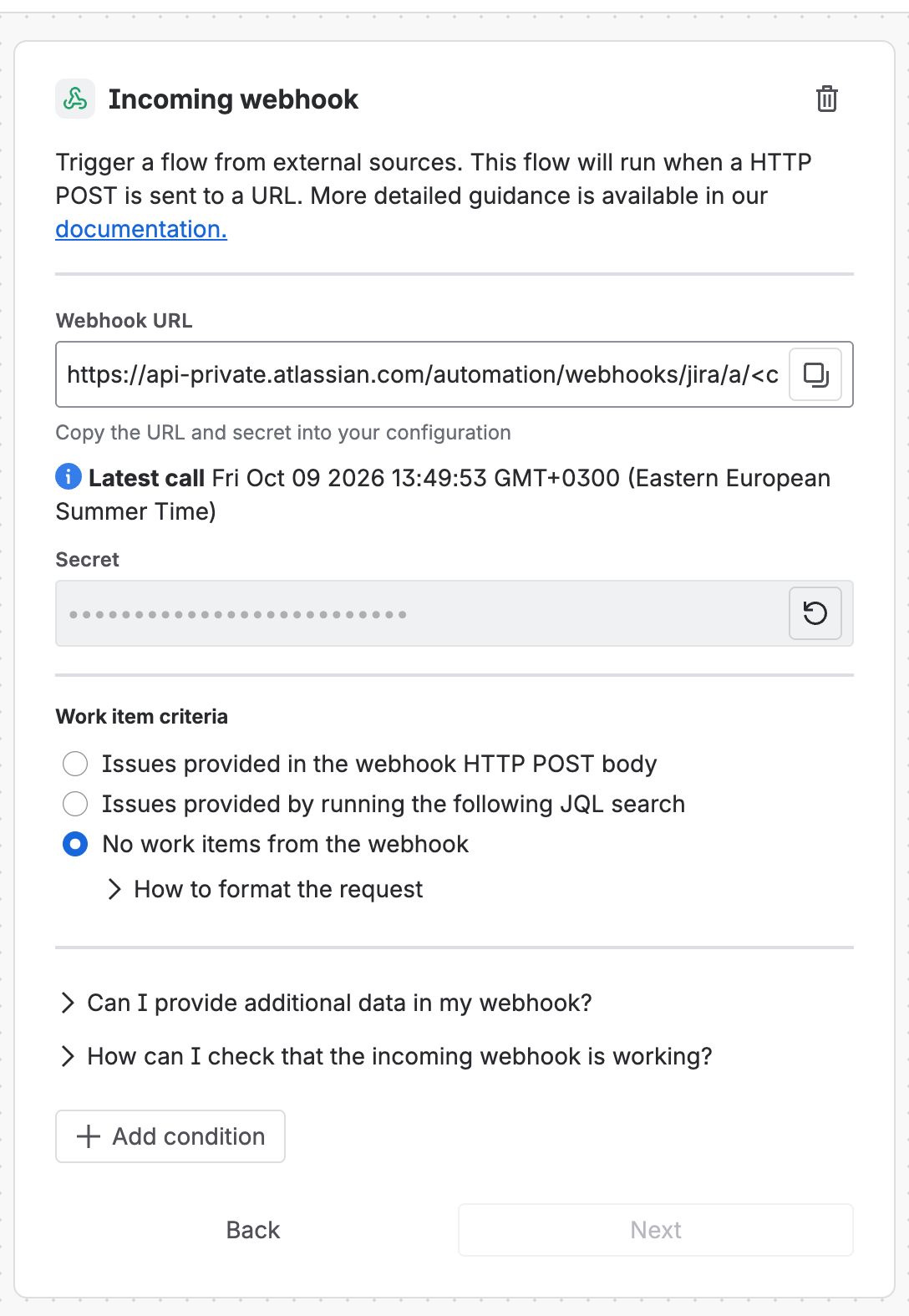
The URL and the secret together are a key. Anyone who has both can create Leads in your CRM. In Zoho CRM the secret sits in the webhook’s header configuration, which only users with the Manage Workflow permission can open. If it leaks, generate a new one; the old one stops working at once.
Step 2. Find record — is this person already a Lead? #
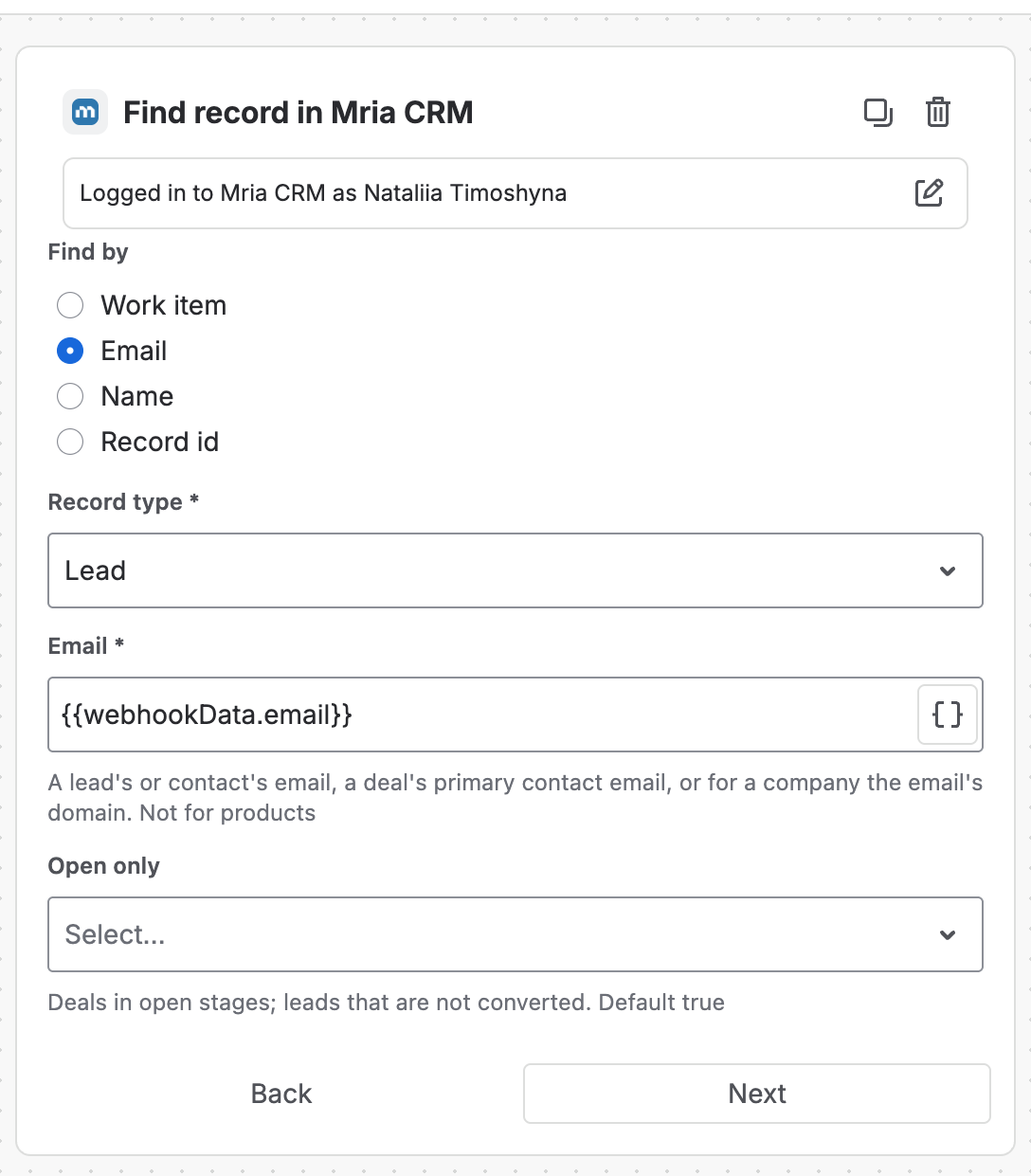
Add Find record in Mria CRM. If this is your first Mria CRM step, click Connect first.
| Field | Value |
|---|---|
| Find by | |
| Record type | Lead |
{{webhookData.email}} |
Step 3. Branch on the result #
Add an If/else block. In the If part choose Add condition → {{smart values}} condition: first value {{fetchedMriacrmRecord.found}}, condition equals, second value false.
Step 4. If not found: create the Lead and link Zoho CRM #
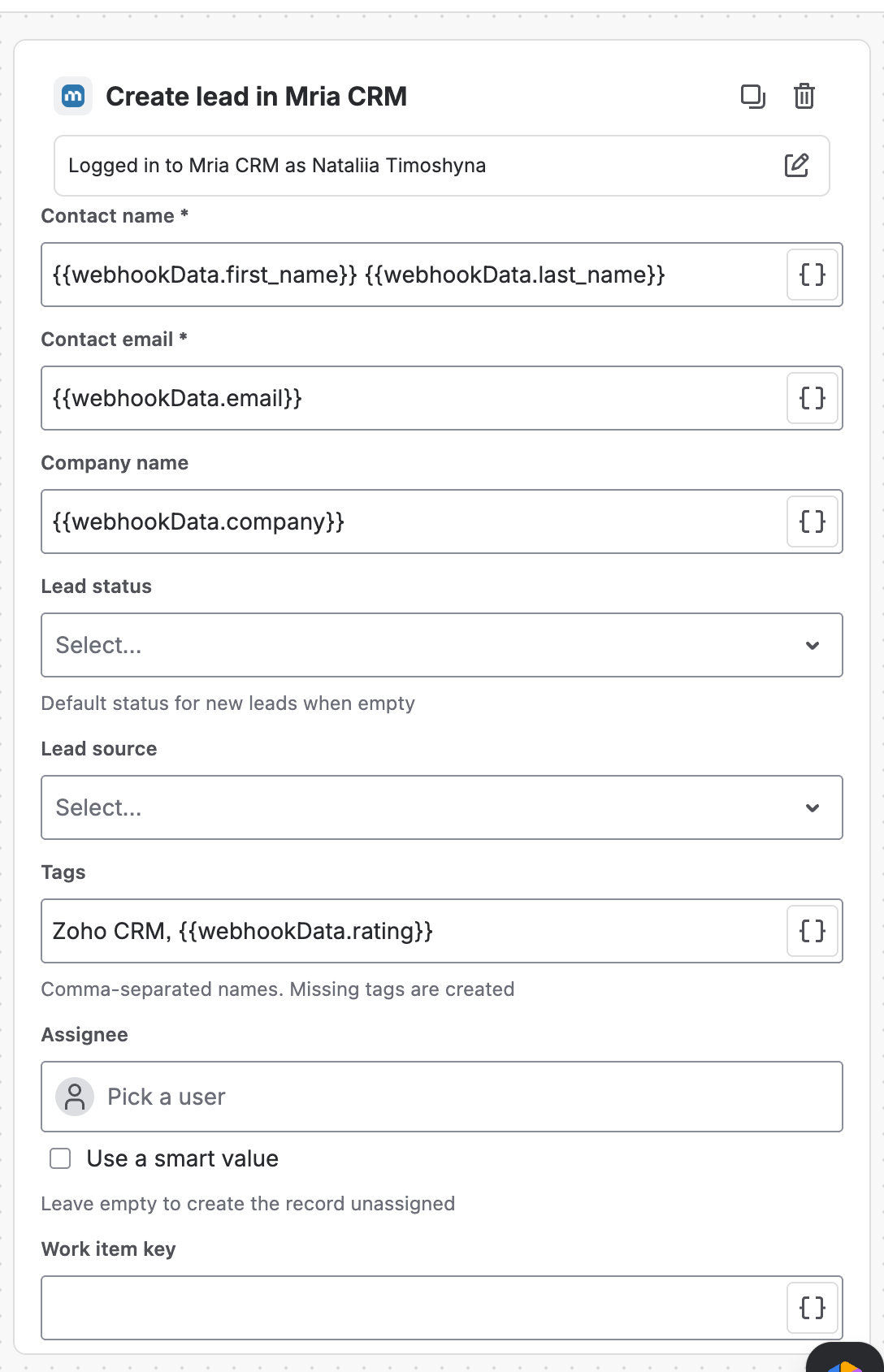
Inside the If part add Create lead in Mria CRM:
| Field | Value |
|---|---|
| Contact name | {{webhookData.first_name}} {{webhookData.last_name}} |
| Contact email | {{webhookData.email}} |
| Company name | {{webhookData.company}} |
| Lead source | empty, or a source that exists in your workspace (Settings → Lead sources) |
| Tags | Zoho CRM, {{webhookData.rating}} — the Zoho rating (Hot, Warm, Cold) becomes a tag; missing tags are created |
| Work item key | empty — there is no work item |
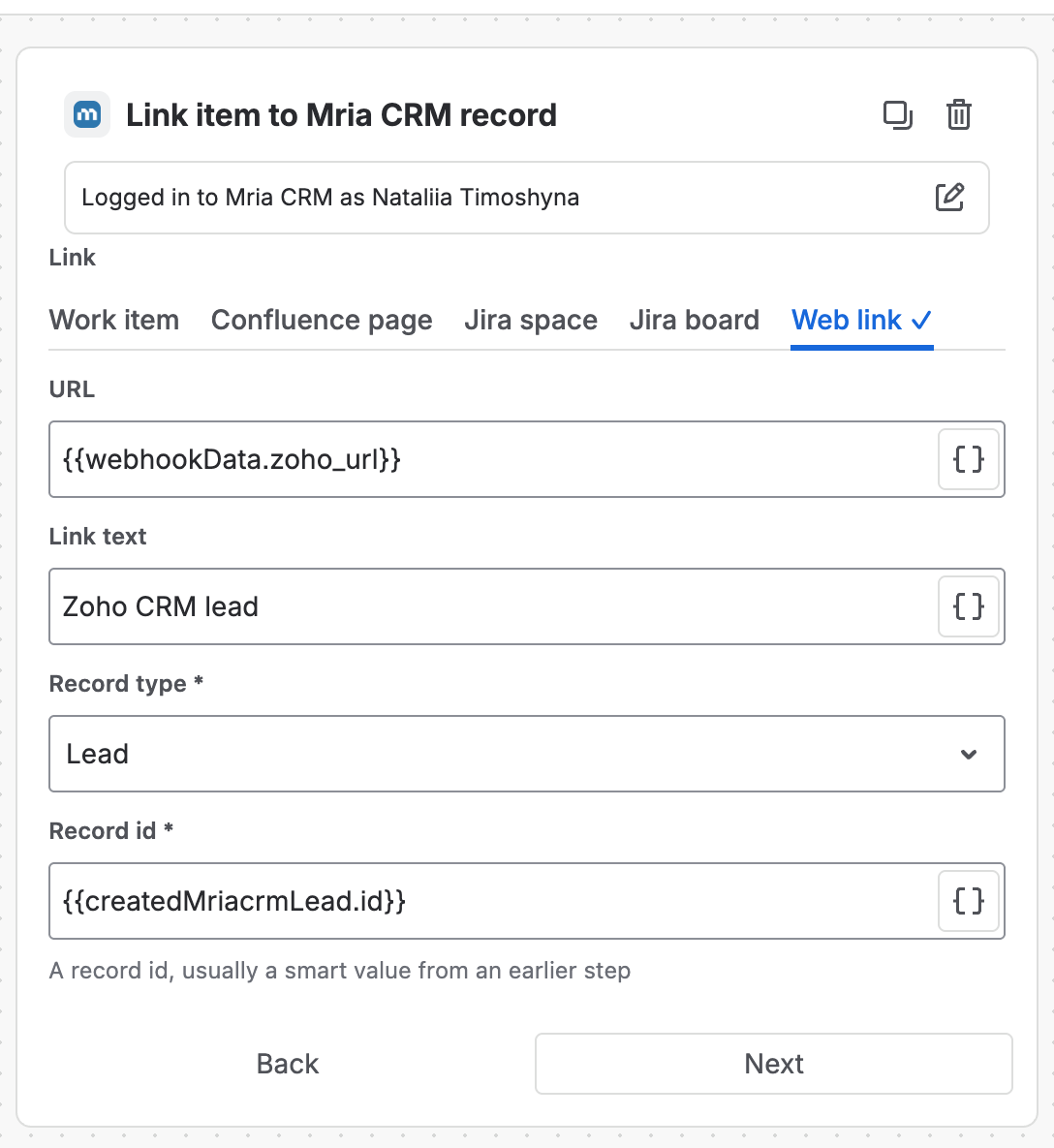
Then Link item to Mria CRM record, tab Web link, so the Lead opens the Zoho record in one click:
| Field | Value |
|---|---|
| URL | {{webhookData.zoho_url}} |
| Link text | Zoho CRM lead |
| Record type | Lead |
| Record id | {{createdMriacrmLead.id}} |
And Add note in Mria CRM with Add to = One record by id, Record type Lead, Record id {{createdMriacrmLead.id}} and this content:
Qualified in Zoho CRM.
Lead status: {{webhookData.lead_status}}
Rating: {{webhookData.rating}}
Lead source: {{webhookData.lead_source}}
Owner: {{webhookData.owner}}
Step 5. Else: tag and note the repeat qualification #
In the Else part add Update lead in Mria CRM with Update = One lead by id, Record id {{fetchedMriacrmRecord.id}} and Tags Zoho CRM, {{webhookData.rating}}. Leave Tags mode empty: its default, add, keeps the tags the Lead already has and adds the new ones.
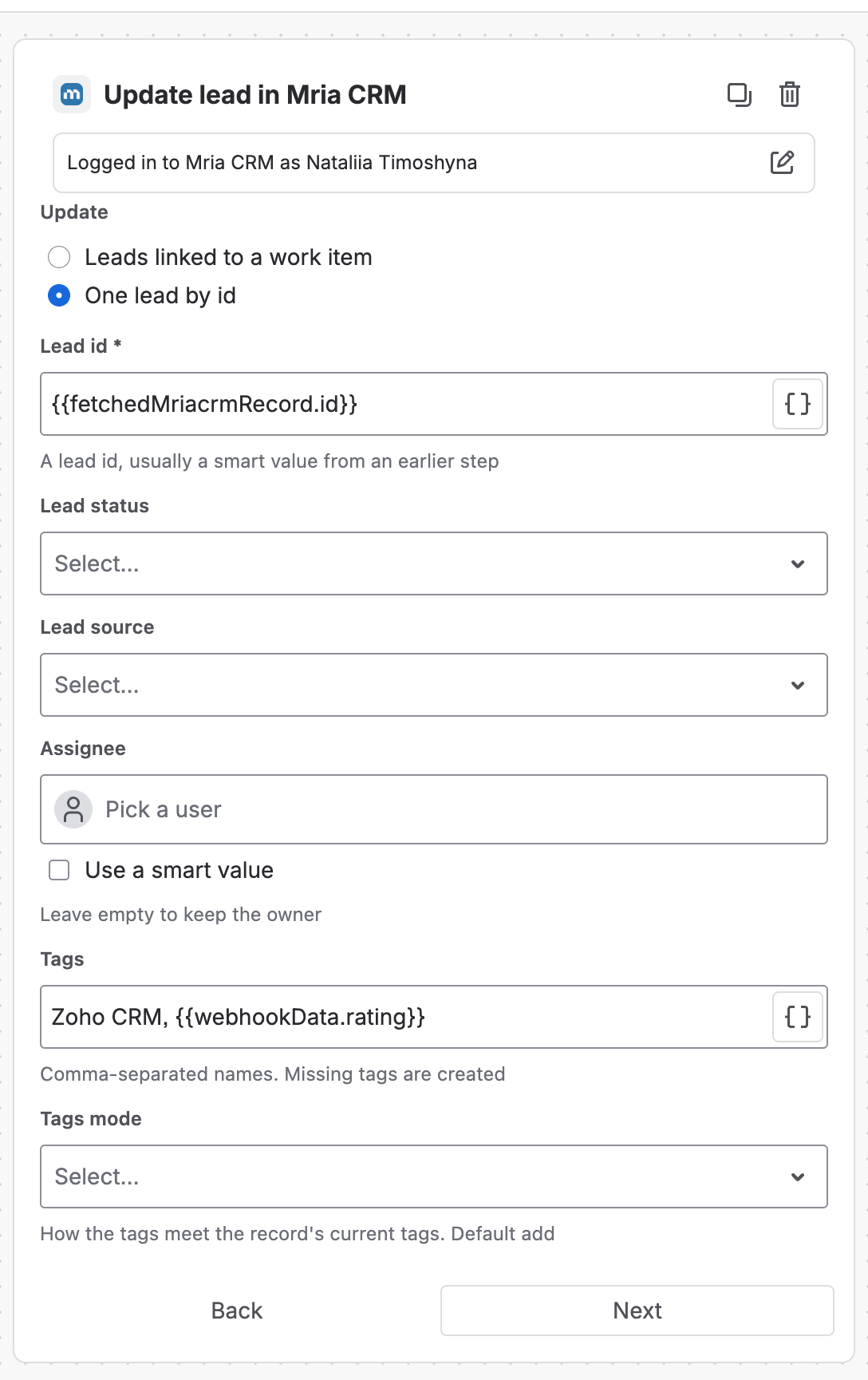
Then another Add note in Mria CRM with Record id {{fetchedMriacrmRecord.id}} and a content such as Qualified in Zoho CRM again. Lead status: {{webhookData.lead_status}} / Rating: {{webhookData.rating}} / Owner: {{webhookData.owner}}.
Step 6. Turn it on #
Save the flow and switch it on. Until it is on, calls to the URL do nothing.
4. Send the lead from Zoho CRM #
In Zoho CRM a webhook is an action you define once and then attach to any workflow rule. It is available to users with the Manage Workflow permission; the daily call allowance depends on the edition (Professional 50,000 calls a day or 100 per user, Enterprise 500,000 or 500 per user, whichever is lower).
Step 1. Define the webhook #
- Open Setup → Automation → Actions → Webhooks and click Configure Webhook.
- Name it (for example Jira Automation — Mria CRM lead), set Method to POST, paste the Webhook URL from the Jira trigger into URL to Notify, choose Module = Leads, and leave Authorization Type on General without credentials.
- Headers: add a Custom Parameter named
X-Automation-Webhook-Tokenwith the secret as its value. Zoho CRM only saves a header section that also has at least one Module Parameter, so add one, for exampleX-Zoho-Lead-Idwith the parameter value Lead Id from the Leads module. Jira ignores it. - Body: set the type to Raw and the format to JSON, then paste the template below. Type
#in the editor to pick a merge field; Zoho inserts it as${Leads.Field Label}. - Click the refresh icon under Preview URL to check the request, then Save.
{
  "first_name": "${Leads.First Name}",
  "last_name": "${Leads.Last Name}",
  "email": "${Leads.Email}",
  "company": "${Leads.Company}",
  "lead_status": "${Leads.Lead Status}",
  "rating": "${Leads.Rating}",
  "lead_source": "${Leads.Lead Source}",
  "owner": "${Leads.Lead Owner}",
  "zoho_url": "https://crm.zoho.com/crm/org<your org id>/tab/Leads/${Leads.Lead Id}"
}
Keep the body to the fields you use. A Zoho CRM webhook passes at most 10 CRM fields; the template above uses nine. The org id for the link is the number in the address bar of any Zoho CRM record, and the domain may be crm.zoho.eu, crm.zoho.in or another data centre.
Step 2. Attach it to a workflow rule #
- Open Setup → Automation → Workflow Rules and click Create Rule for the module Leads.
- Trigger on a record action: Edit with Lead Status among the modified fields, or Create or Edit if new leads can arrive already qualified.
- Condition: Lead Status is Qualified. Add Rating is Hot if only hot leads should cross over.
- Under Instant Actions choose Webhooks, pick the webhook from step 1 in the Call Webhook dialog, click Associate, then Save the rule.
Zoho CRM shows the last seven days of webhook calls under Setup → Automation → Actions → Webhooks (More Info), with a failure reason for each call that did not get a 2xx answer. A failed call is retried once, 15 minutes later.
Test it from a terminal #
The same request Zoho CRM sends, with a sample lead:
curl -X POST '<webhook URL from the trigger>' \
  -H 'Content-Type: application/json' \
  -H 'X-Automation-Webhook-Token: <secret from the trigger>' \
  -d '{"first_name": "Priya", "last_name": "Nair", "email": "priya.nair@meridianhospitality.com",
       "company": "Meridian Hospitality Group", "lead_status": "Qualified", "rating": "Hot",
       "lead_source": "Trade Show", "owner": "Daniel Reyes",
       "zoho_url": "https://crm.zoho.com/crm/org71234567/tab/Leads/5725767000000412019"}'
5. Check that it worked #
Open the flow’s Audit log. Every accepted call is a row; expand it to see each step and which branch ran. The Lead itself shows the link and the note on its page.
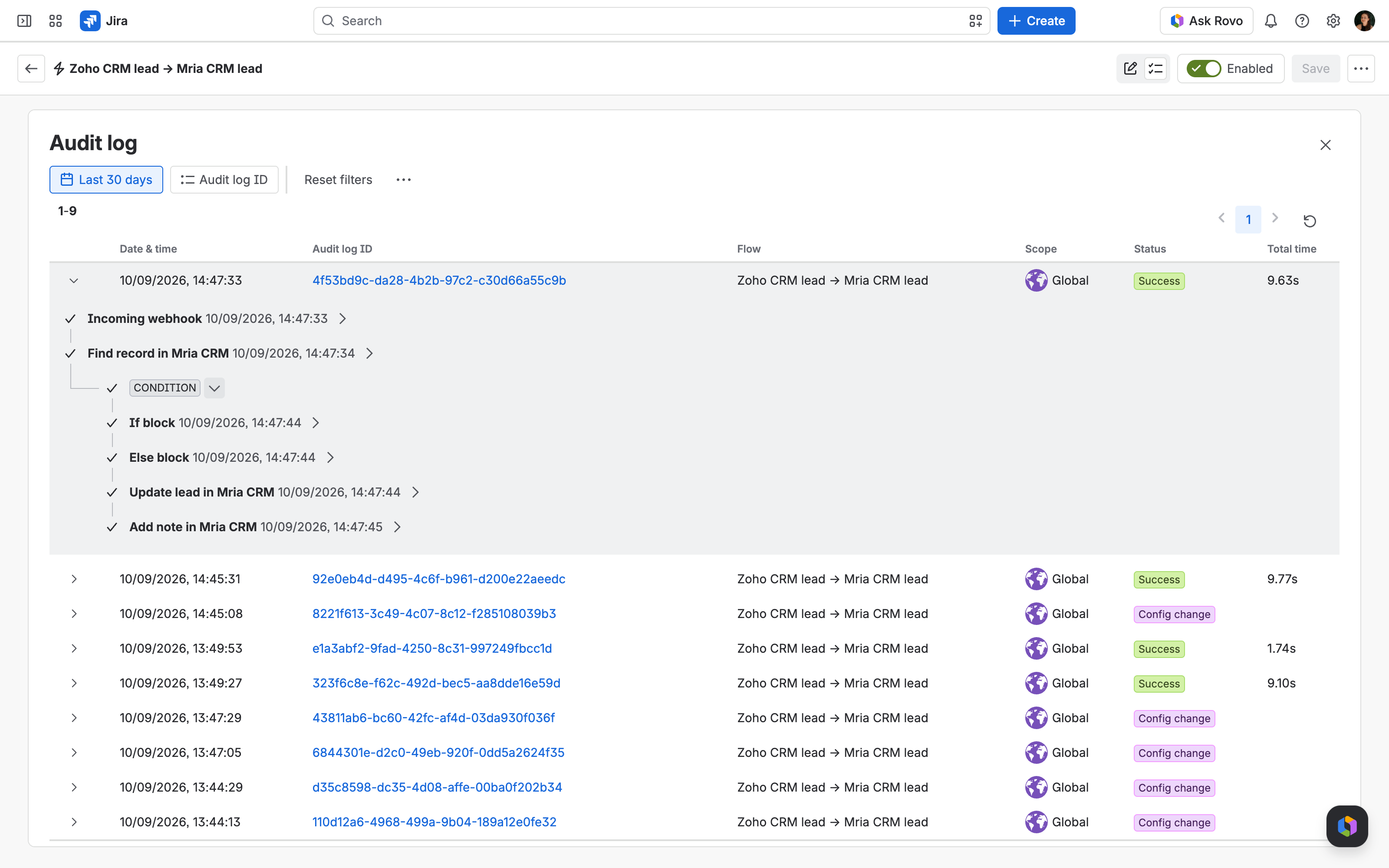
A wrong secret is answered with HTTP 200 and nothing runs. Jira acknowledges the request but drops it silently, so Zoho’s webhook usage shows a successful call while the audit log stays empty. Only a request with no secret at all gets a 400. If the audit log has no row for a call, check the header first.
6. Make it yours #
- Route by owner. Send
${Leads.Lead Owner.Email}asowner_emailand branch on it to set the Lead’s Assignee. - Deals instead of leads. Define a second webhook on the Deals module, trigger on Stage and use Create deal with a pipeline and stage of your choice; see the Actions Reference.
- Close the loop. A workflow rule on Lead Status is Junk Lead or Not Contacted can call a flow whose Else branch runs Update lead with status Lost.
- Time-based actions. Zoho CRM can call the same webhook from a scheduled action, for example two days after a lead was qualified without an activity; the Jira flow stays the same.
7. Troubleshooting #
| What you see | Why, and what to do |
|---|---|
| Zoho shows a successful call, the audit log has nothing | The secret in the header is wrong or the header name is not exactly X-Automation-Webhook-Token: Jira answers 200 and drops the call. Compare the Custom Parameter with the trigger’s secret. |
| Zoho will not save the header section | A header section needs at least one Module Parameter. Add one (any Leads field) next to the custom token parameter. |
| The Lead is created but a field is empty | The key in the JSON template and the smart value differ, or the merge field label does not match your org (custom field labels vary). Open the webhook’s Preview URL and compare. |
| Create lead fails on Lead source | The source Zoho sends does not exist in the workspace. Add it under Settings, or leave the field empty. |
| The same person became two Leads | Find record must search by the same email the Lead is created with, and the body must carry the Email field. |
| Zoho reports Socket timeout or Request Failed | Jira did not answer within 10 seconds, or answered with an error. Zoho retries once after 15 minutes; check the flow is on. |
| Aborted — Monthly flow executions have been exceeded | The site reached its monthly automation usage. Runs resume next month or on a larger plan; Zoho’s single retry will not cover that gap, so re-trigger the rule later. |
Related Pages #
- Jira Automation — how Mria CRM steps work, and the other use cases.
- Automation Actions Reference — every field of Find record, Create lead, Link item and Add note.
- HubSpot Leads to Mria CRM — the same flow fed by a HubSpot workflow.
- Pipedrive Leads to Mria CRM — the same flow fed by Pipedrive, with the secret in the URL.
- Zoho CRM: Webhooks — Zoho’s documentation of the webhook action and its limits.


